

The Serengeti stretches across nearly 15,000 km² of grass plains, riverine forest, and rocky kopjes, and gives its name to an ecosystem that spans well beyond the park's own borders. Over two million wildebeest, zebra, and gazelle move through it in a year-round circuit, trailed by some of Africa's densest populations of lion, cheetah, and leopard.
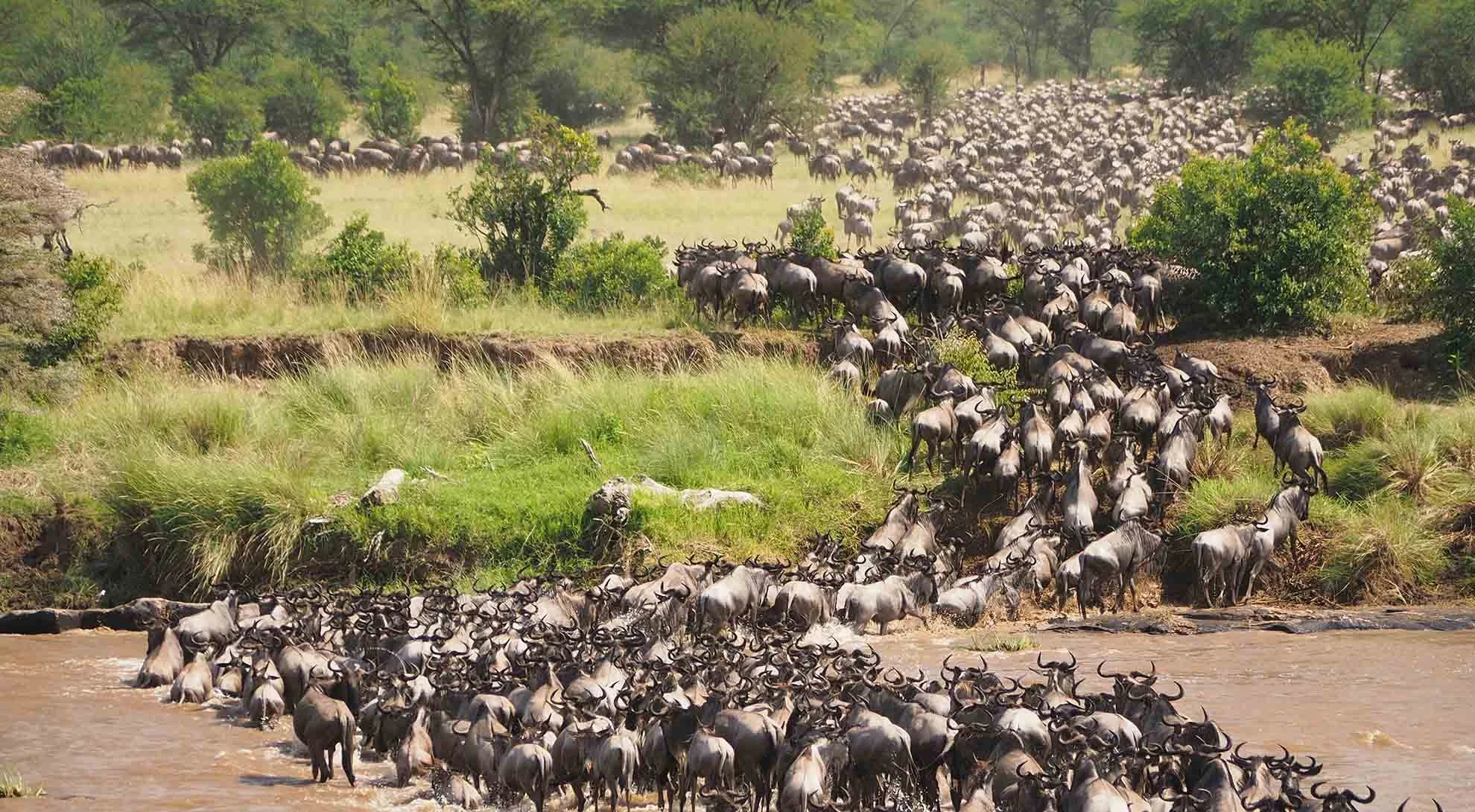
Serengeti National Park — endless plains, and the world's greatest migration.
Famous for the wildebeest migration, dense predator sightings, endless open plains, and iconic granite kopjes.
Year-round wildebeest migration
Dense lion & cheetah populations
Iconic granite kopjes
Balloon safaris at dawn
Full-service crew: guides, drivers & camp staff
A Glimpse of the Serengeti
Endless plains, river crossings, and big cats on the move



Why It Matters
A park built around perpetual motion
The Serengeti's size and open terrain are what let a migration of over two million animals move through it continuously, following rainfall rather than a fixed route. That same scale means where you base yourself matters: the migration's location shifts through the year between the southern plains, western corridor, and northern Mara region.
Success comes down to matching your dates to where the herds are likely to be, and choosing a camp positioned for that stretch of the circuit rather than a fixed address.
Park Size
~14,750 km²
Migration Herd
2M+ wildebeest & zebra
Predator Density
Among Africa's highest
Typical Duration
3–5 Days
The Approach
The anchor of any northern circuit itinerary
The Serengeti sits at the far end of the road from Arusha, past Lake Manyara and Ngorongoro, with its own network of airstrips for those flying in directly. Most itineraries treat it as the centrepiece, with two or more nights split across different regions depending on the season.
Access
Road or scheduled light-aircraft flights
Drive From Arusha
~6–8 hours (central Serengeti)
Best Season
Year-round, region-dependent
Timing the Migration
Roughly December to March in the south, June in the western corridor, and July to October in the north.
How We Time It
We track the herds' likely position for your dates and base you in the region that puts you closest to them.
The name comes from the Maasai word "siringet," meaning the place where the land runs on forever.
Park Regions
Four regions that define Serengeti game viewing
Each region offers a different balance of terrain, migration timing, and scenery. We help match the right circuit to your dates and interests.
Southern Plains
Calving season (Dec–Mar)
Western Corridor
Grumeti River crossings (Jun)
Northern Serengeti
Mara River crossings (Jul–Oct)
Central Seronera
Year-round resident wildlife
Granite Kopjes
Lion & leopard lookouts
Balloon Safaris
Dawn flights over the plains
Game Drives
Morning, afternoon & night
Accommodation
Camps & lodges by region
Region Highlights
Popular circuits for wildlife and scenery.
- Seronera Valley
- Northern Mara
- Southern Plains
- Western Corridor
Worth Planning Around
Key factors for a strong Serengeti itinerary.
- Migration timing versus chosen region
- Road transfer time versus flying between camps
- Pairing with Ngorongoro and Lake Manyara
Four regions, one continuous circuit, following the largest overland migration on earth.
Open plains, river lines & rock outcrops, to the horizon.
The southern Serengeti opens into short-grass plains that run flat to the horizon, ideal for calving season and long, unbroken sightlines. Further north, riverine forest follows the Grumeti and Mara Rivers, and granite kopjes rise abruptly from the grassland, giving lion and leopard a natural vantage point over the plains below.
- Short-grass plains
- Riverine forest
- Granite kopjes
- Acacia woodland
- Grumeti & Mara Rivers
- Open savannah
The terrain shifts by region, which is exactly what allows the migration to keep moving throughout the year.
A park whose scale gives rise to the greatest wildlife spectacle on the continent.

Where You'll Actually Go
Seven landmarks that define a visit to the Serengeti
01
Seronera Valley
The park's central hub, with reliable year-round sightings of lion and leopard.
02
Mara River
The site of the migration's dramatic northern crossings, roughly July to October.
03
Southern Plains
Short-grass plains where wildebeest gather each year to calve.
04
Granite Kopjes
Ancient rock outcrops scattered across the plains, favoured lookouts for big cats.
05
Western Corridor
Riverine forest along the Grumeti River, home to crossings and resident hippo pods.
06
Balloon Safari Launch Sites
Dawn departures for a sunrise flight over the herds and plains.
07
Moru Kopjes
A rock formation with ancient Maasai rock paintings and a resident rhino sanctuary.
A single ecosystem offering a different chapter of the migration story in every region.
How We Build Your Visit
Ways we shape a Serengeti itinerary around you
Expert driver-guides
Guides who track the migration's daily position and know where the resident predators are holding.
Morning & afternoon drives
Game drives timed for predator activity and, in season, river crossings.
Hot air balloon safari
A sunrise flight over the plains, followed by a bush breakfast on landing.
Night drives
Ranger-led evening drives in permitted concession areas for nocturnal predators.
Combine with the northern circuit
Add the Serengeti as the anchor stop alongside Ngorongoro and Lake Manyara.
Multiple ways to experience the Serengeti's migration and plains at the right pace for you.
The Short Version
What You're Actually Getting
In One Line
Vast open plains built around the largest overland wildlife migration on earth.
The Serengeti offers exceptional predator density and a different migration chapter depending on when and where you visit.
What You'll See
| Wildebeest | Zebra | Lion | Leopard |
| Cheetah | Elephant | Giraffe | Spotted hyena |
| Topi | Hippo | Crocodile | Over 500 bird species |
Private & Custom
Same wilderness, shaped around what you're here for
Combine game drives with a hot air balloon safari, a night drive, or a multi-region migration route according to your interests and schedule. We design the visit that gives you the best of the Serengeti's landscapes in the time you have.
Tell us your priorities, and we'll build the Serengeti visit that fits you — not a one-size-fits-all itinerary.
Migration-timed itineraries
Hot air balloon add-on
Multi-camp, multi-region routes
Night drive for nocturnal species
Combine with Ngorongoro/Manyara
Group or private safaris